

Sharks found in Thailand include blacktip reef sharks, whitetip reef sharks, leopard (zebra) sharks and whale sharks. This guide focuses on these four species, their identifying features and the Phuket dive routes to consider.
Phi Phi and Shark Point offer different reef-diving experiences, while seasonal northern routes reach the Similan and Surin area. Choose a trip that suits your qualification and recent experience, then enjoy the reef as well as any wildlife encounter.
Start with the whole dive: choose a route that suits your experience and offers reefs or scenery you will enjoy. Sharks are wild animals, so sightings vary and cannot be guaranteed.
Sharks to look out for in Thailand

Blacktip reef shark
Look for a slim body and prominent dark markings on the fins, especially the first dorsal fin. Blacktip reef sharks use shallow coastal and reef habitats, so an encounter can sometimes happen surprisingly close to the surface.
They may move away quickly when approached. Stay still, keep your distance and let the shark continue along its own route.
Whitetip reef shark
This slender shark has pale tips on its first dorsal fin and upper tail. It can rest on the seabed, often near caves or ledges during the day, and becomes more active at night.
If your guide spots one resting, observe from outside its shelter. Avoid crowding the entrance or trying to make it swim out for a photograph.
Leopard shark (zebra shark)
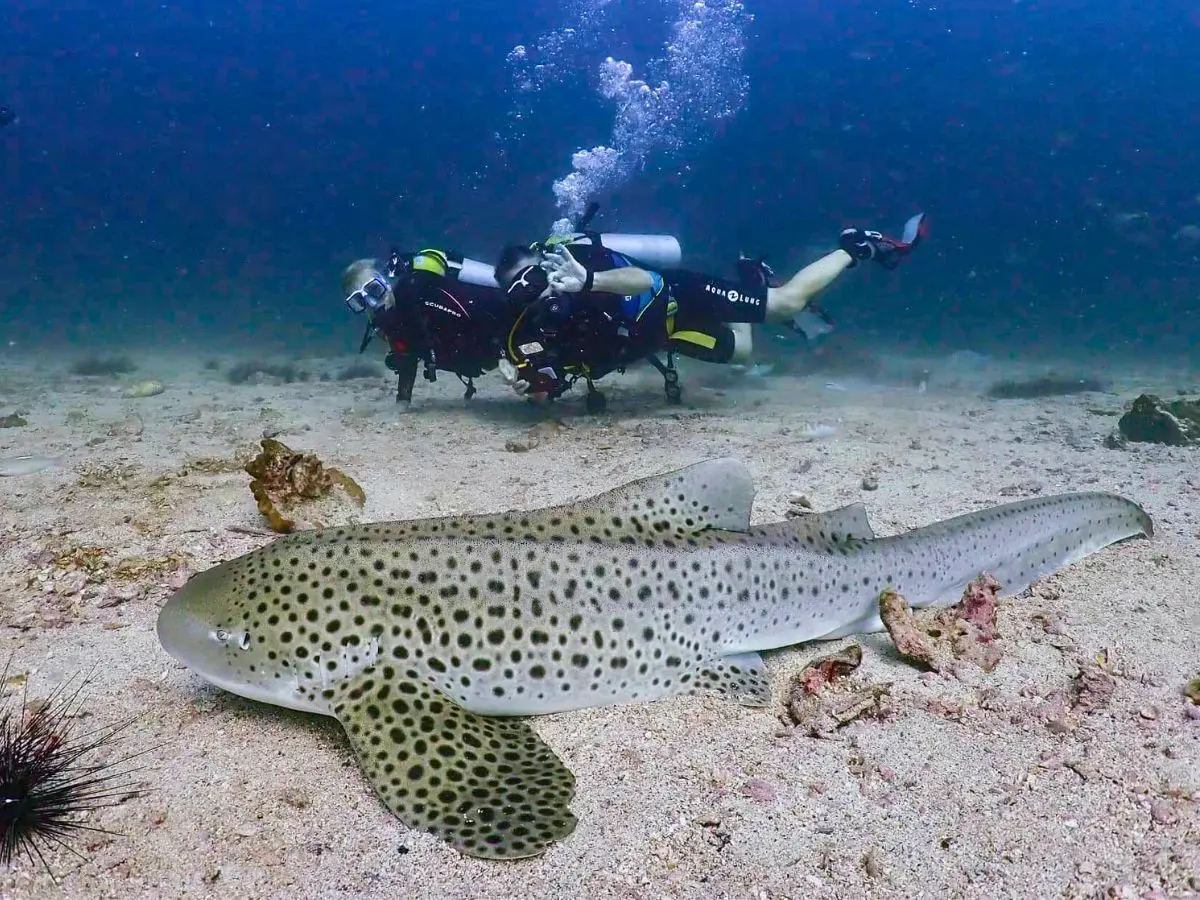
The spotted shark commonly called a leopard shark in Thailand is the zebra shark (Stegostoma tigrinum). Juveniles have stripes; adults develop spots. The name “leopard shark” is also used for a different species along the Pacific coast of North America, so the name alone can be confusing.
Its rounded head and very long tail help distinguish it from reef sharks. It may rest on sand near a reef during daylight, so good buoyancy is particularly useful when watching one.
Whale shark
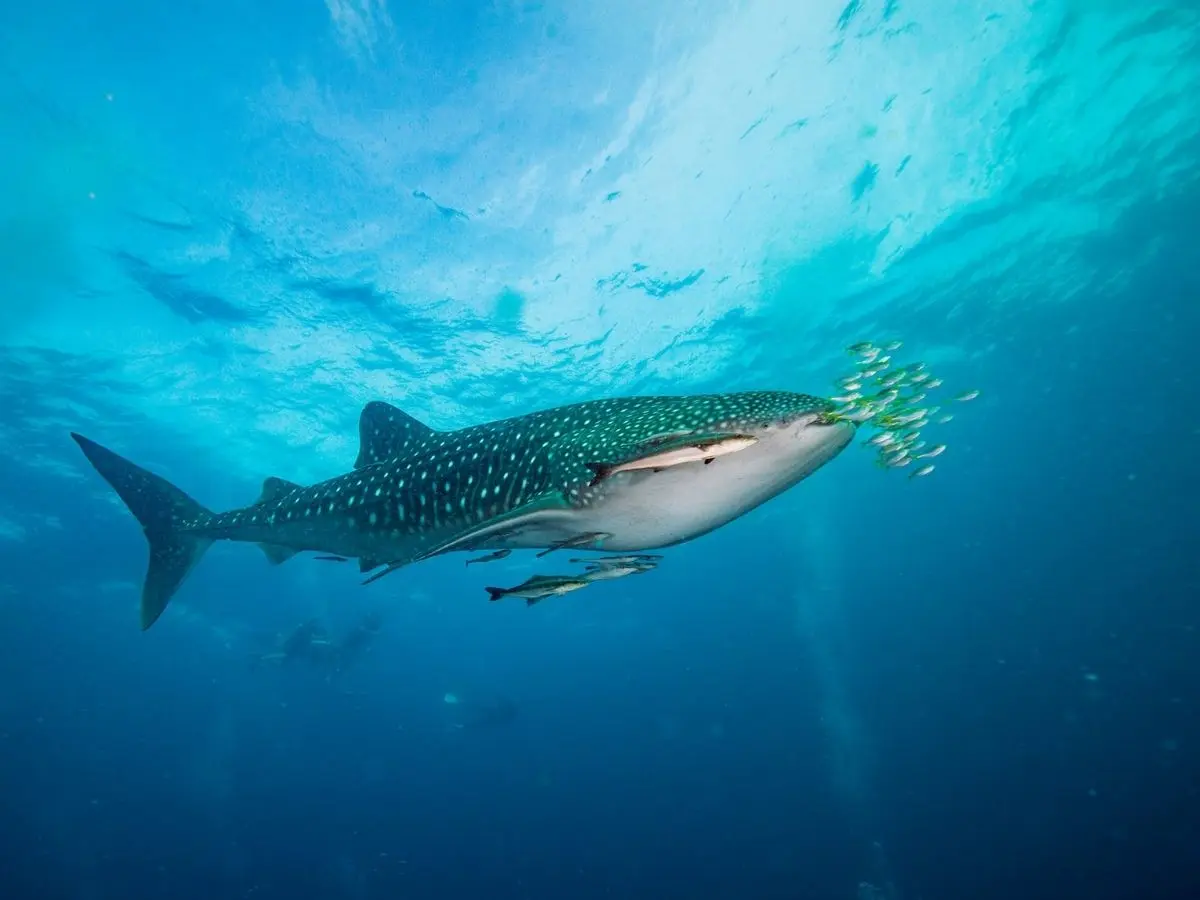
A broad head and a pattern of pale spots identify this filter-feeding shark. Encounters feel very different from seeing a smaller shark beside the reef: the animal may pass through open water and continue on its way.
For seasonal routes and practical planning, read our whale shark diving guide.
Where can you dive with sharks from Phuket?
Phi Phi: reef sharks and limestone scenery
Around the Phi Phi reefs, blacktip reef sharks and leopard sharks are species to look out for among the wider marine life. The current Thailand Divers day trip is for certified divers, including Open Water or equivalent. Your guide chooses sites for the conditions and the group; sightings are never guaranteed.
Compare the day’s route and requirements on the Phi Phi diving trip.
Shark Point: choose it for the reef, too
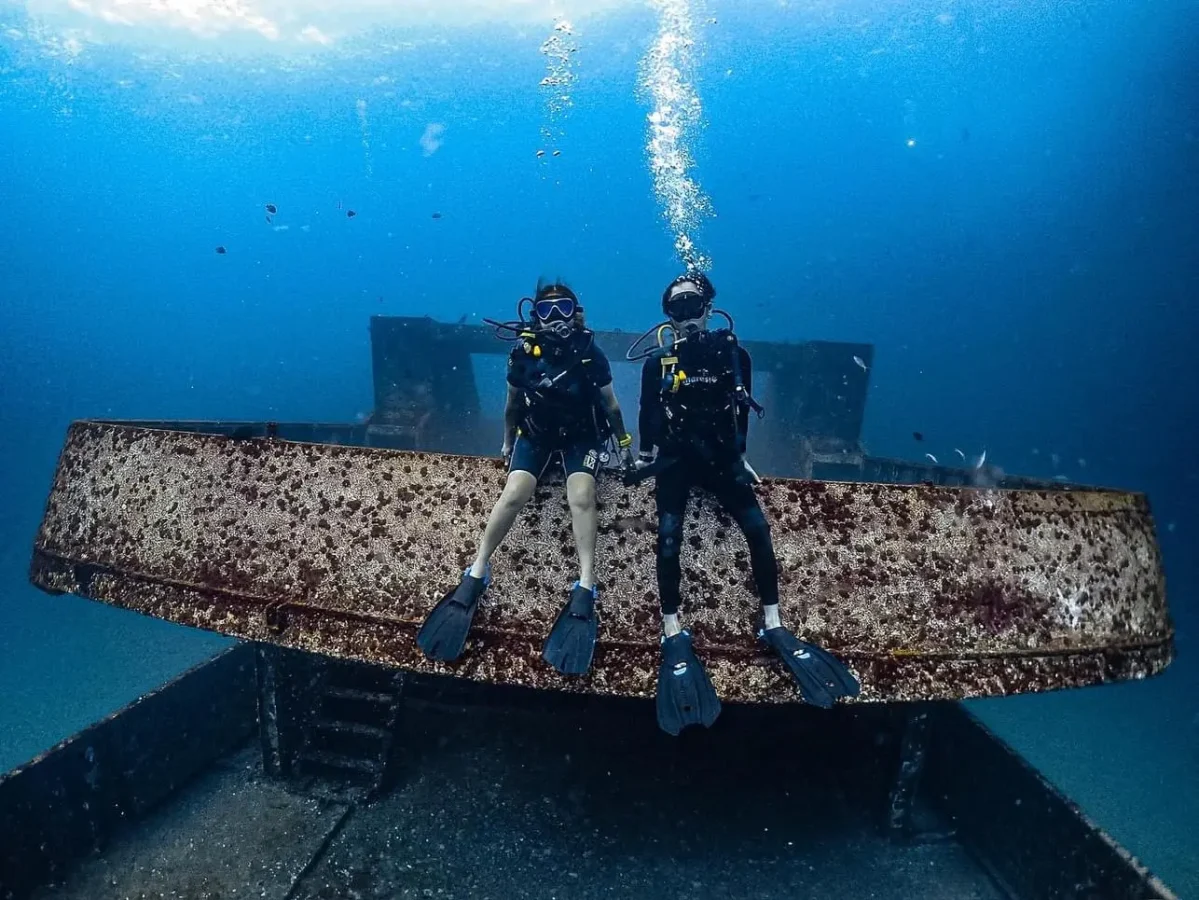
Shark Point is known for reef structure, soft corals and varied marine life. Its name does not mean sharks will be present on every dive. Thailand Divers combines it with King Cruiser Wreck and Koh Doc Mai on an Advanced-diver route.
Check the King Cruiser and Shark Point itinerary before deciding whether this is the right day for your certification and recent experience.
Racha Islands: a broader reef-diving day
The Racha Islands offer a broader reef-diving day for certified divers. Choose this route for its reefs, island scenery and sites suited to your experience. A shark encounter is a possible extra, rather than the focus of the itinerary.
The Racha Yai and Racha Noi guide explains the differences between the islands. See the current Racha Islands three-dive day trip for the itinerary and booking details.
Northern routes: more time exploring offshore
Seasonal Similan and Surin-area trips open up a different part of the Andaman Sea. Richelieu Rock is associated with whale-shark trip planning, but belongs to the Surin-area route, not the Similan Islands themselves.
Compare the Richelieu Rock day trip with the northern liveaboard options, and check each route’s sites, experience requirements and operating dates.
Make the most of a shark encounter
A calm group gives both the animal and the divers more space. Listen to the briefing before entering the water, agree how your guide will signal a sighting and keep your buddy in view.
- Let the shark set the pace. Avoid chasing, touching, feeding or blocking its path.
- Stay balanced in the water. Keep fins and equipment clear of coral and sand.
- Leave resting animals room. Do not surround a shark or obstruct its shelter.
- Keep the dive plan in mind. Watch your depth, air and buddy rather than following an animal away from the group.
- Photograph without disturbing wildlife. Keep your distance and follow the briefing. Before bringing a camera, check Thailand’s underwater camera rules and the requirements for your trip.
Protecting Phuket’s leopard sharks
Thailand’s Department of Marine and Coastal Resources reported in October 2025 that the StAR Thailand project had released three tagged leopard sharks near Maiton Island. Its tracking network covers important habitats around Phuket, Phang Nga and Krabi, including Shark Point and the Phi Phi area.
The project asks divers to leave monitoring equipment untouched. Enjoy a sighting without chasing or handling the shark, and ask your guide about responsible ways to contribute an existing photograph to shark research. Read the DMCR conservation report.
Questions about sharks in Thailand
Are sharks dangerous to divers?
Sharks are wild animals and no encounter is risk-free. The approach on a recreational dive is passive observation: follow your guide, leave space and avoid provoking or pursuing the animal. If you feel uneasy, tell your guide before the dive so you can discuss what to expect.
Can snorkellers see sharks too?
Some species use shallow water, so sightings while snorkelling are possible. Follow local swimming and park rules, stay with your guide and do not enter a restricted area to approach wildlife. A dive-site recommendation does not automatically make that location suitable for snorkelling.
What is the best month to see sharks?
There is no single month that guarantees sightings across species and sites. Choose travel dates around the route’s operating season, then ask about current conditions and recent observations. Recent sightings are useful context, not a promise for the next trip.
Do I need to be an advanced diver?
It depends on the dive site and itinerary. Some reef dives suit newer certified divers; the King Cruiser and Shark Point combination is listed for Advanced divers. Tell the team your qualification and last dive so the recommendation fits you.
Guide updated 12 October 2026. Identification references: Florida Museum profiles for blacktip reef sharks, whitetip reef sharks, zebra sharks and whale sharks. Responsible encounter guidance: PADI shark and ray tourism advice.
 4.8/5
4.8/5 Read on Google